






Every Restaurant’s Tech Stack Looks Different. The Priorities Don’t.
November 3, 2026
Written by

SHARE ON SOCIAL




Every restaurant brand’s tech stack looked different this year. The priorities driving where they invested didn’t.
As Q4 sets in, it’s tempting to publish a list of predictions for next year. We’re skipping that.
This is a look back at what we actually saw shape restaurant technology priorities in 2026, based on the implementations, technical assessments, and day-to-day work our team did alongside restaurant operators all year.
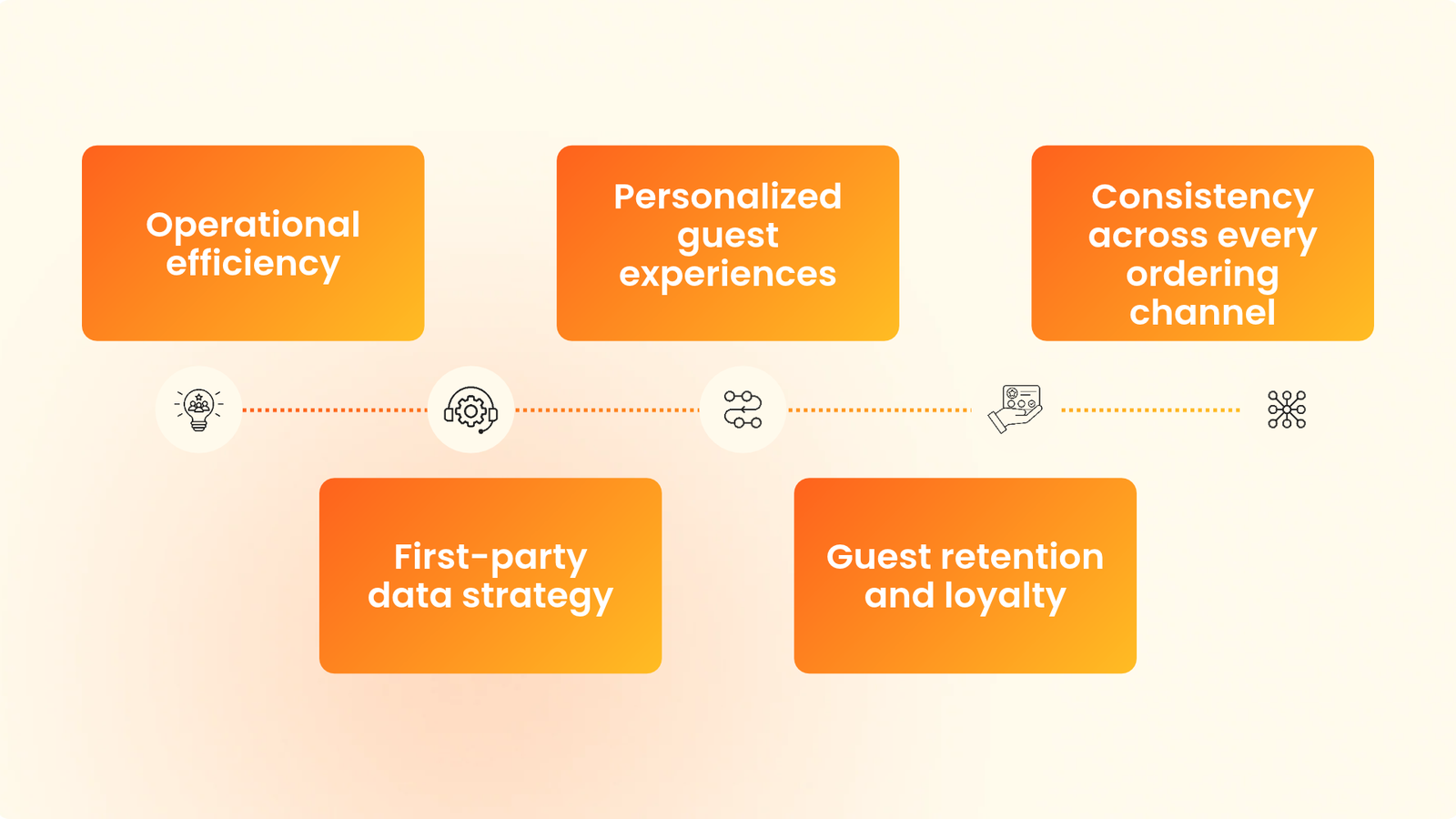
No two brands we worked with ran the same tech stack. Some leaned on all-in-one platforms. Others assembled specialized tools system by system. But underneath that variation, the same priorities kept showing up:
The insights throughout come from across our leadership team, on the ground with these brands all year: Shae Kovisto, Associate Director of Technical Operations; James Carson, Director of Technical Operations; Ashley Prieto, Director of Client Operations; and Ilyssa Perez, Director of Loyalty and Marketing Operations.
The Stack Isn’t the Differentiator
Most brands now have access to similar technology. POS platforms, loyalty engines, online ordering, and delivery integrations all do roughly what you’d expect on their own.
“The tech stack isn’t the differentiator anymore.”
— Shae Kovisto, Associate Director of Technical Operations
What separates brands, in Shae’s experience, is how thoughtfully those tools, and the data feeding them, are structured to work together.
That shift matters for how brands should be shopping. James Carson, Director of Technical Operations, saw it play out repeatedly in our work guiding restaurant brands through technology evaluations (RFPs) and vendor selection: a best-of-breed stack now lines up close to even with an all-in-one bundle once proposals are compared apples to apples.
Price isn’t the argument for consolidating anymore. The real question is how well the systems actually talk to each other, which is exactly why more brands are bringing in 5&5 for strategy consulting before signing with a vendor rather than after. Left unchecked, that kind of misalignment becomes its own cost of complexity — one most brands don’t notice building until it’s already slowing their teams down.
Omnichannel Consistency Is Architecture, Not Duplication
A recurring assumption we ran into this year: a POS menu should simply copy across every ordering channel. It rarely works that cleanly.
A POS is built for a team member to move through an order quickly. A guest-facing digital menu needs something different:
– More context and product detail
– More customization options
– Fewer of the friction points that only make sense when a person is asking the questions in person
Brands that get this right, Shae noted, design their menu structure around what each channel actually needs from the start, not as a patch after launch. That’s the difference between a system that can grow with the brand and one that eventually needs to be rebuilt.
“Inconsistency across channels is one of the fastest ways to erode guest trust.”
— Ashley Prieto, Director of Client Operations
Ashley sees the same pattern from the client side: as orders flow through first-party, third-party, catering, and every channel in between, pricing, promotions, and fulfillment expectations have to stay aligned no matter where the order started. With so many channels to manage at once, that alignment can slip without anyone noticing until a guest is already caught in the gap. That inconsistency creates just as much confusion for the digital ordering teams trying to fulfill those orders correctly.
Complexity, Not Technology, Is What Actually Slows Brands Down
One example from this year captures the cost of unmanaged complexity well.
A brand came to us with more than 500 modifier groups, each maintained individually, because every new menu choice had been bolted on as its own configuration. Every LTO update took longer than it should have, and the brand had little room left to handle the last-minute changes that always come with them.
The fix wasn’t new technology. It was consolidating those 500-plus modifier groups into a handful of shared ones and letting the POS configuration determine what displays on each item, based on factors the brand already had built into its menu.
The result: LTO maintenance dropped from a heavy manual process to a fraction of the effort, and the team got its time back for the requests that actually needed attention.
The same pattern shows up with regional menu testing. Brands often start with a few smart, targeted market variations, then keep adding exceptions without revisiting whether the original menu structure still makes sense. We’ve seen that spiral into 15-plus overlapping core menus across channels, to the point where maintaining the complexity costs more than the market-specific strategy was ever worth.
The brands that scale well treat their menu as a living part of their tech ecosystem, not a fixed list — circling back regularly to ask which variations still earn their keep and which can be folded back into a shared structure. That ongoing evaluation is exactly where the 5&5 team partners with brands: helping them spot how a new item or regional tweak ripples through their systems before it becomes next year’s 500 modifier groups, and building the habits that keep menu strategy proactive instead of reactive.
Clean Data Is What Makes AI Worth the Investment
AI-assisted workflows moved from a roadmap item to an actual line item on vendor proposals this year, particularly for menu optimization and dispute handling.
However, James was direct about a limitation nobody puts on the sales page: if a menu is overly complex, full of messy, duplicated menu data, or inconsistently structured, AI has nothing clean to work from. It will hand back recommendations built on that same mess.
The brands positioned to get real value out of AI next year are the ones that spent this year fixing their underlying structure, not the ones that added a new tool on top of an unresolved problem.
The same discipline applies to how configuration changes are handled day to day. Self-service menu and pricing tools give brands more control, but a change applied more broadly than intended rarely throws an alert. It shows up weeks later as an incorrect total that someone has to work backward to reconcile and identify the source of the discrepancy.
The teams handling this well treat configuration changes like a software release:
– Know exactly what a change touches
– Verify it before it goes live everywhere
– Have one owner who knows how to back it out if needed
Loyalty Remains a Relationship, Not a Transaction
Guest retention showed up differently on the loyalty side. Ilyssa pointed to three shifts her team tracked all year:
1. Brands are seeking more opportunities to create customer value beyond discounts and transactional rewards.
2. Tracking customer behavior and needs beyond the four walls and digital ordering channels is becoming increasingly important to building a more complete view of the guest.
3. Tracking offer margins and promotion economics is critical to ensuring loyalty programs drive sustainable bottom-line growth.
“The next evolution of loyalty isn’t just about earning and redeeming points.”
— lyssa Perez, Director of Loyalty and Marketing Operations
That shift means using what you learn about a guest to understand their full relationship with the brand, not just their last transaction, and giving them a genuine reason to choose that brand again. It’s exactly the kind of personalized, first-party data strategy our loyalty management team partners with brands to build and support.
Execution Still Decides Who Gets the Value
None of this works without strong implementation. Ashley and her team see this most clearly in how differently rollouts land.
Brands that pair a new platform with clear ownership, real UAT and QA, and solid launch planning get the value they signed up for. Brands that treat implementation as an afterthought usually don’t, regardless of which implementation partner or platform they chose.
James raised the same point from a staffing angle. The best technology on the market doesn’t mean much without a team that has the bandwidth to run it well. Lean teams look efficient on paper, but if nobody has time to manage a rollout or a complicated configuration, that gap eventually reaches the guest who’s just trying to order dinner.
The Bottom Line
Every brand we worked with this year had a different stack. None of them had a different set of priorities.
Operational efficiency, guest experience, and retention all came back to the same root cause: how thoughtfully the technology and the data behind it were structured to work as one system, not a pile of disconnected tools.
That’s where 5&5 comes in: the restaurant industry’s point of sale and digital platform management company, an embedded team of specialists who help brands turn POS, loyalty, and everything between into one working system.
Every stack looks different. Is yours structured to work as one system?
FAQ
Why doesn’t a restaurant’s tech stack matter as much as it used to?
Most restaurant technology platforms, from POS to loyalty to online ordering, now offer similar core capabilities. What actually separates brands is how thoughtfully those tools and the data feeding them are structured to work together, not which specific vendors a brand chose.
How do you set up a limited-time offer in a restaurant POS system?
Setting up an LTO correctly means building it as a unique line item from day one — including any variants (like different sauces or sizes) as their own separate entries — then configuring modifiers, allergen and nutrition data, and an auto-86 trigger so it disappears everywhere at once when the promotion ends. Skipping any of these steps at setup makes it difficult or impossible to get clean performance data later.
What are the essential components of a modern restaurant tech stack?
Most restaurant tech stacks are built from the same core pieces: POS platforms, loyalty engines, online ordering, and delivery integrations. In 2026, having those components wasn’t what separated brands, nearly every brand had access to similar technology. What mattered was how thoughtfully those systems, and the data feeding them, were structured to work together rather than operating as disconnected tools.
Should a restaurant menu be identical across every ordering channel?
No. A POS is designed for a team member to move through an order quickly, while a guest-facing digital menu needs more customization options and context. Brands that replicate a single menu structure across every channel typically create more manual work and a worse guest experience than brands that design each channel’s menu around what that channel actually needs.
Why does menu complexity slow down restaurant operations?
Unmanaged complexity, like hundreds of near-duplicate modifier groups or overlapping regional menus built up over years of one-off exceptions, makes every update slower and harder to maintain. Consolidating that structure into shared, flexible configurations, rather than adding new technology, is usually what actually speeds operations back up.
Does AI actually improve restaurant operations?
AI-assisted tools can meaningfully help with menu optimization and dispute handling, but only when they’re working from clean, well-structured data. A menu with hundreds of overlapping modifier groups gives AI nothing reliable to learn from, so the brands seeing real returns from AI in 2026 were the ones that fixed their underlying data structure first.
What makes a restaurant technology implementation successful?
Strong implementations come down to execution, not just the platform chosen: clear ownership, thorough user acceptance testing and QA, and solid launch planning. Brands that treat implementation as an afterthought tend to get less value out of even top-tier technology than brands that plan the rollout as carefully as the purchase decision.
Related Resources
Restaurant Technical Operations: Supporting Scalable Digital Growth
Why Every LTO Touches More Than Your Menu
What Is a Restaurant New Store Opening (NSO)?
Rethinking Restaurant Loyalty in a Value-Driven Era
Why Gamified Loyalty Is Changing the Game

Caroline is a Loyalty and Marketing Operations Specialist at 5&5, supporting blog and campaign content through research and optimization. She focuses on copy and content strategy for branding and growth marketing, turning complex ideas into clear, engaging messaging. She enjoys collaborating with teams, solving content challenges, and improving performance while bringing a creative perspective from outside of her marketing work that shapes her approach to storytelling.

Leave a Reply