







Why Every LTO Touches More Than Your Menu
August 12, 2026
Written by

SHARE ON SOCIAL




Limited-time offers (LTOs) aren’t just a menu decision — they’re a system-wide event. Every LTO ripples through POS configuration, restaurant menu modifiers, inventory and accounting, kitchen workflow, and digital menus, often all at once.
The operators winning today aren’t succeeding because of constant menu change. They’re succeeding because they execute it well. That’s the differentiator at 5&5: We don’t just support menu launches, we build the LTO menu technology and systems that make rapid menu innovation scalable and profitable.
If you run a multi-unit, QSR, or beverage-forward brand, here’s what’s actually happening every time an LTO hits your menu, and why the brands winning today have built the digital systems that make rapid menu innovation scalable.
LTOs Are Growing Faster Than Ever
LTOs are becoming a bigger part of the restaurant industry every year — not a passing trend. As reported by Restaurant Business, citing Technomic data, LTO launches have jumped 157% since 2019 — from just over 16,000 that year to nearly 43,000 projected this year. Consumer appetite is climbing right alongside it: the same reporting notes that the share of consumers who say new LTO launches matter to them has grown substantially since 2022, with the strongest interest coming from Millennials, Gen Z, and higher-income diners.
That combination of rising launch volume and rising consumer demand signals a bigger shift: menu innovation is no longer an occasional marketing event. It’s becoming a continuous operating model. And that shift means digital execution isn’t just a marketing function anymore — it’s a strategic capability.
The real challenge isn’t risk. It’s operational complexity. As LTOs multiply across an increasingly fragmented digital ecosystem, every launch has to be configured correctly across ordering platforms, loyalty systems, campaigns, reporting, and guest-facing digital experiences. 5&5 doesn’t build the menu items themselves — we operationalize them, configuring the technology and processes that let brands gather real performance data, decide whether an item earns a permanent spot, or maximize profit on the seasonal hype while it lasts. That’s a big part of why we’re seeing more LTOs across the industry, from beverages to food and back again, and why digital execution (not menu innovation alone) is what makes that growth scalable.
Beverage-Led Brands Prove the Model — But “Simple” Still Means Digital
Beverage LTO trends show why: because a new drink often requires zero new prep lines or kitchen equipment, beverage concepts can launch LTOs constantly with far less back-of-house disruption than food-forward brands. Beverage-led brands are a clear example of what’s possible when continuous menu innovation is backed by strong digital execution.
But “simple” doesn’t mean “free.” Even the easiest-looking beverage LTO is still a full digital menu event. As announced by Black Rock Coffee Bar, the chain’s chief marketing officer described its limited-time Coco Lime Dirty Pop — a collaboration with OLIPOP — as a chance to put Black Rock’s own spin on the growing dirty soda trend, and another example of how the brand keeps evolving its menu with intention. No new kitchen workflow was needed for that launch — but the item still had to be built out across:
– POS — new SKU, size-based pricing tiers, correct tax/category mapping
– Modifiers — customization options like size, add-ins, or sweetness level
– Nutrition & allergen data — updated and synced wherever it’s displayed
– Digital ordering & delivery platforms — app, website, and third-party marketplace listings
– Start/end date logic — an auto-86 trigger so the item disappears everywhere at once when the promotion ends
– Digital menu boards & marketing assets — in-store screens, app banners, imagery
That’s a real, non-trivial digital footprint, and it illustrates the bigger pattern: every LTO touches nearly every digital guest touchpoint. As launch frequency increases, digital execution, not the next product idea, becomes the competitive advantage.
👉🏻 5&5’s work with Black Rock Coffee Bar shows what that looks like in practice.
Scale that same checklist up, and it’s easy to see why most brands stick to smaller, incremental LTOs. Which is what makes Ruby Tuesday’s summer 2026 menu drop worth paying attention to: 14 new items across six categories, launched simultaneously, nationwide. As reported by Restaurant Business, Ruby Tuesday’s chief marketing officer explained that the brand normally runs about six LTOs a year, but chose to go bigger this time to attract new customers and introduce new flavors. Pulling that off successfully, all at once, isn’t a sign of complexity spiraling out of control — it’s a sign of a brand whose systems could actually support that scale of coordinated change.
The gap between beverage and food LTOs isn’t that one requires digital menu management and the other doesn’t. It’s a difference of scale, and the brands built to handle that scale are the ones who turn it into a genuine competitive advantage, the way Ruby Tuesday just did.
What Actually Happens When You Launch an LTO
Every LTO ripples through modifiers, restaurant POS integration, inventory and accounting, delivery-platform sync, and kitchen throughput, often all at once.
Done right, an LTO isn’t just a marketing moment. It’s a live test, but the real value isn’t that an LTO generates data. It’s that strong digital execution is what makes that data reliable enough to inform real business decisions: operational efficiency, smarter investment, and scalable innovation, rather than a menu item that quietly fails to deliver ROI with no clear explanation why.
As NetSuite explains, LTOs are a low-risk way to test new items and pricing — tracking performance lets operators adjust portioning or pricing for optimal margin before deciding what earns a permanent spot on the menu. That insight matters more than ever: the same source notes that a large majority of restaurant operators have seen food costs rise in the past year, and more than half have had to cut menu items just to adapt. This is exactly where 5&5’s role comes in — helping brands operationalize continuous menu innovation through strong digital execution.
The Data Blind Spot
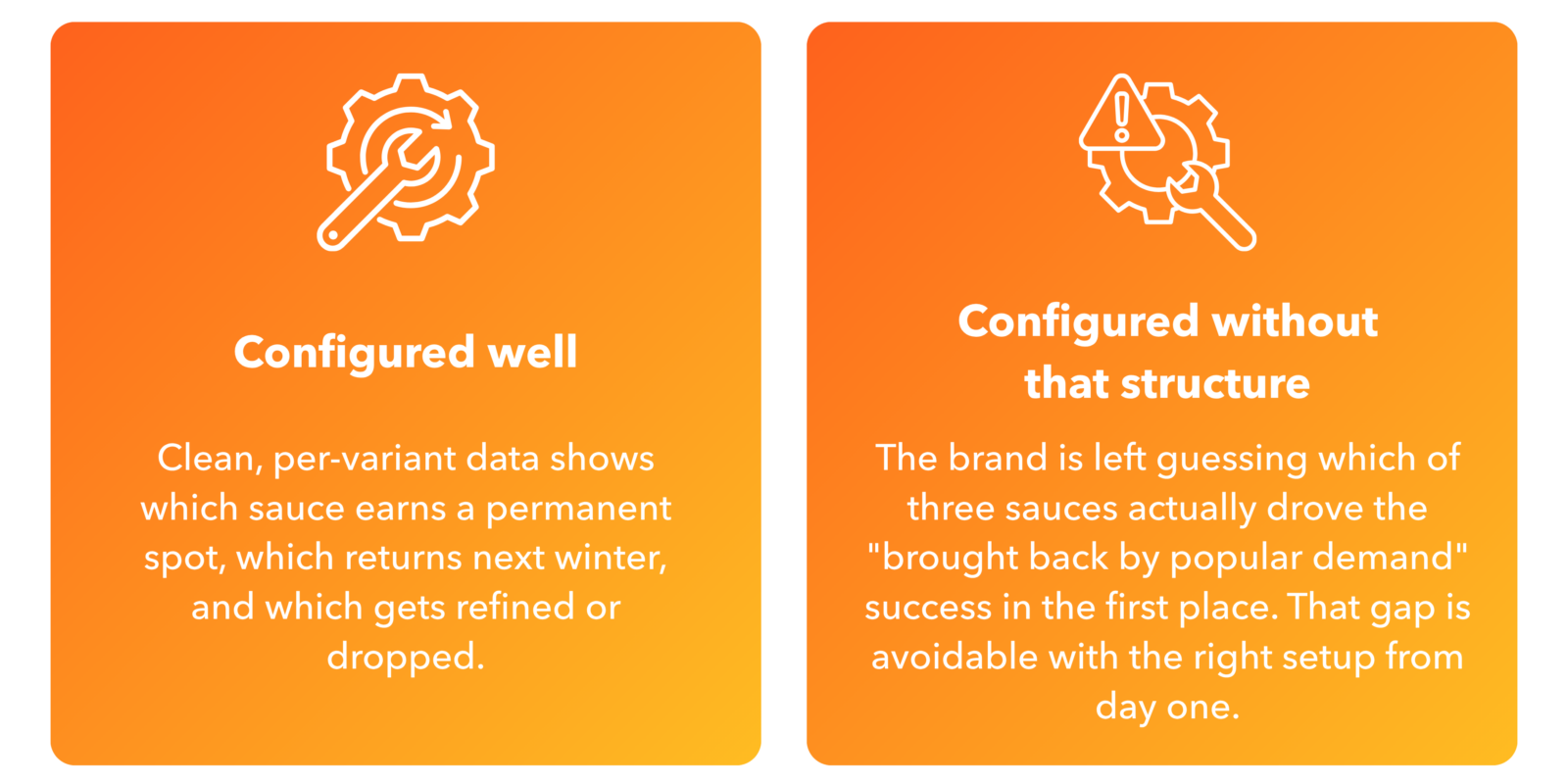
As reported by QSR Magazine, Flame Broiler relaunched its Charbroiled Wings nationwide in three sauce variants — Magic, Original Spicy, and Korean Spicy — bringing the item back by popular demand.
That kind of data-driven decision only works if each sauce is built as its own distinct item in the POS from day one. Lump all three into a single “Char Wings” line item, and a brand loses the ability to see which variant actually drove results: the exact insight an LTO is supposed to provide. This is the bigger story behind configuration decisions: how a brand builds its digital systems determines the quality of the data it can rely on for every future menu decision.
The Tech Stack Test
The real test of an operator’s tech stack isn’t whether it can launch an LTO. It’s whether it can support smart menu engineering by ending it cleanly. Can you 86 menu items in your POS everywhere at once, across every location and every channel, the moment the promotion window closes? Are modifiers, pricing, and nutrition data synced across the POS, app, and third-party delivery platforms, or does each system need to be updated by hand? Brands that can answer yes without a scramble are the ones equipped to execute continuous menu innovation consistently and profitably — not just occasionally.
What Operators Should Do About It
Continuous menu innovation is no longer an occasional marketing push. It’s a permanent operating model. And digital execution, not another product idea, is what makes that model scalable.
That’s where 5&5 comes in. We’re the partner that helps hospitality brands operationalize continuous innovation across their entire digital ecosystem. We’re platform-agnostic, built to act as an extension of your team, from consulting to full management of your restaurant tech stack. Whatever that looks like for your brand, we help you grow profitably, execute consistently, and innovate without adding complexity.
Is your digital ecosystem built to help you grow profitably?
FAQ
How can restaurant POS systems manage limited-time menu specials?
A POS system manages an LTO by treating it as its own distinct item — not folded into an existing category — with its own SKU, modifiers, pricing tier, and a built-in start/end date so it can be added and removed automatically across every location. Done correctly, this also means the item is tracked separately in sales reporting, so operators can see exactly how it performed rather than guessing.
How do you set up a limited-time offer in a restaurant POS system?
Setting up an LTO correctly means building it as a unique line item from day one — including any variants (like different sauces or sizes) as their own separate entries — then configuring modifiers, allergen and nutrition data, and an auto-86 trigger so it disappears everywhere at once when the promotion ends. Skipping any of these steps at setup makes it difficult or impossible to get clean performance data later.
What software solutions help track the performance of restaurant special offers?
The most useful tools are those built into a restaurant’s POS and menu-management systems, which capture real-time sales data for each item. 5&5 partners with platforms like Restaurant365, which add another layer of reporting and provide more customizable product-mix analysis than many POS systems provide alone. This lets operators categorize menu items, recipes, and inventory specifically for LTO tracking. Accurate menu and inventory data make LTO reporting meaningful. As NetSuite explains, this helps operators understand profitability, optimize pricing and portions, and determine whether an item deserves a permanent spot on the menu.
Are restaurants using technology to boost sales through limited-time offers?
Yes — LTO volume has grown significantly in recent years, and brands with strong digital infrastructure are best positioned to capitalize on it. As reported by Restaurant Business, citing Technomic data, LTO launches have jumped 157% since 2019, and consumer interest in these launches continues to climb, especially among younger and higher-income diners. Brands that can launch, track, and retire these offers cleanly across every channel are turning that demand into a real competitive advantage.
What restaurant technology integrates loyalty programs with seasonal promotions?
Loyalty platforms that connect directly to a restaurant’s POS and ordering systems allow seasonal LTOs to automatically qualify for point-earning, targeted offers, and personalized promotions — without separate manual setup for every campaign. This kind of integration is part of what 5&5 supports through its Loyalty Management services, helping brands turn short-term promotions into longer-term customer relationships.
What should restaurant technology handle when managing limited-time offers?
At minimum, a restaurant’s tech stack should handle five things for every LTO: POS configuration (SKU, pricing, modifiers), nutrition and allergen data, delivery-platform and app sync, automatic start/end-date logic, and clean performance tracking. Brands whose systems can do all five without manual intervention are the ones equipped to run LTOs at scale rather than treating each one as a one-off project.
Related Resources
5&5 POS Platform Management | Multi-Location Restaurant Systems
5&5 Black Rock Coffee Tech | Scaling 50 to 100+ Locations
5&5 Loyalty Program Management
5&5 Online Ordering Management
5&5 Restaurant Digital Implementation | POS & Tech Setup

Leave a Reply